Battery Type/'s
-Flooded Lead Acid BatteriesBatterySeasoning (Break-in)
When the batteries are new, makesure to charge the battery pack before its first use. Limit the use of newbatteries for first five cycles. Newbatteries are not capable of their rated output until they have been dischargeda number of times. It takes 90-120 cyclesto fully maximize range.
BatteryCycling and Life
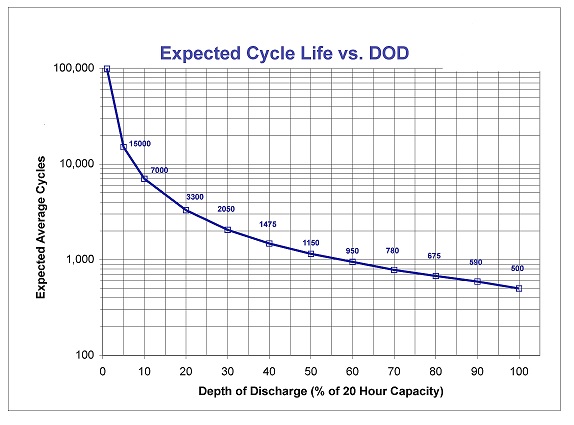
Do not excessively dischargebatteries. Excessive discharge (below 63volts) can cause polarity reversal of individual cells resulting in completefailure shortly thereafter. Routinelyheavy discharging will also reduce the battery overall life as shown in Table 2below. The battery depth of discharge asit relates to overall battery life is also shown in this table. Limited use of new batteries will alsominimize the chance of cell reversal. Charge the batteries to their full state every two months whether youhave used them or not to ensure they will not fully discharged.
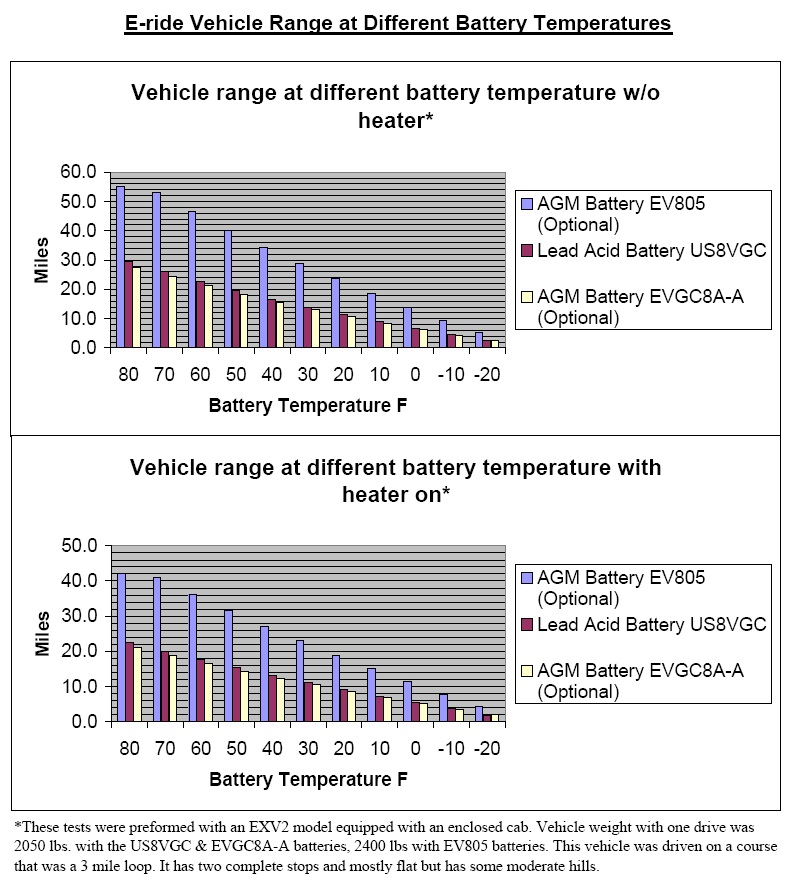
How temperature affects a batteries available capacity and chargetime
A batteries available capacityvaries at various temperatures. As the ambient temperature rises a batteriesability to deliver current increases. As the temperature falls, so does thebatteries ability to deliver current.
Cleaning and Maintenance
Make sure to fill batteries withwater monthly or promptly when there is any indicated need. The batteries must be refilled with distilledor de-mineralized water to avoid internal damage. Electrolyte levels lower during discharge andrise during charge. Therefore, it is mandatory that water be added to cells ONLY when theyare fully charged. Older batteriesmay require more frequent watering than new batteries. (See section 2.2 forbattery watering procedure)
Keep the top of the batteries cleanand dry to insure longer lasting, trouble-free operations. Also, make certain the battery cables arealways tightly fastened to the battery terminals. Make sure the cables are tight to theterminals but be careful not to over tighten. Any corrosion present onthe batteries or terminals should be cleaned promptly by brushing them off witha wire brush. The acid can beneutralized with a solution of baking soda and water.
Lead Acid Storage
If the vehicle will be stored forany period of time, check battery electrolyte level, adjust level if needed andthen connect battery charger to vehicle. Allow charger to re-main connected tovehicle during storage to prevent battery discharge and potential batterydamage. If the vehicle will be stored for more than 30 days and the batterycharger cannot be used for some reason, charge the batteries fully. Eitherstore batteries on a shelf or in the vehicle. Store the batteries in a coolatmosphere to avoid quick deterioration of the charge in the batteries. Toprevent batteries from freezing, make sure they are fully charged beforestorage. During the storage period, charge the batteries at least once everythree (3) months to prevent battery damage. Before returning the vehicle toservice, make sure to fully charge the batteries. Batteries ending there lifecan discharge faster.
Do not park the vehicle and leaveit for any length of time with discharged batteries. The batteries coulddischarge to the point where damage could occur and the battery charger willnot charge. If you allow the vehicle tosit in conditions of 32°F (0°C) or less with a state of charge of20% or less, the batteries couldfreeze. If the batteries happen to freeze, it may cause damage to thebatteries and permanently reduce their capacity. The battery case could also crack if it isfrozen. Inspect for this beforeattempting to thaw. Place the vehicle inan area greater than 32°F andallow it to warm up before charging. Never charge the vehicle if the batteriesmay be frozen.
When storing batteries duringoff-season or any time while the vehicle is not in use for any length of time,follow these guide lines to help keep the batteries in good condition.
1. Keepthe batteries clean and free of corrosion as outlined in section 3.5.3.
2. Fullycharge the batteries prior to storage.
3. Storein a cool area. The colder temperaturein which the batteries are stored, the less they will self discharge. Batteries stored at 0°F will discharge very little over a four month period. Batteries stored at 80°F will have to be recharged every few weeks.
4. Thefrequency of recharging required will depend on the temperature of the storage area, but it isrecommended that the batteries be monitored for state of charge every month. Also, if the storage area is unheated in acold climate recharge is required. It isrecommended that the area be heated to at least 60°F prior to charge. Batteries do not charge effectively in cold temperatures for the samereason that they do not discharge as rapidly in cold temperatures.
5. Checkthe state of charge periodically. Batteries that are discharged and left in the cold environment canfreeze and crack. If the specific gravity drops below 1.220, the batteriesshould be recharged. See Table 2 below.
The following table shows the freezing point of a batterybased on the specific gravity of the acid. This gives a guideline for working temperatures at a certain specificgravity.
